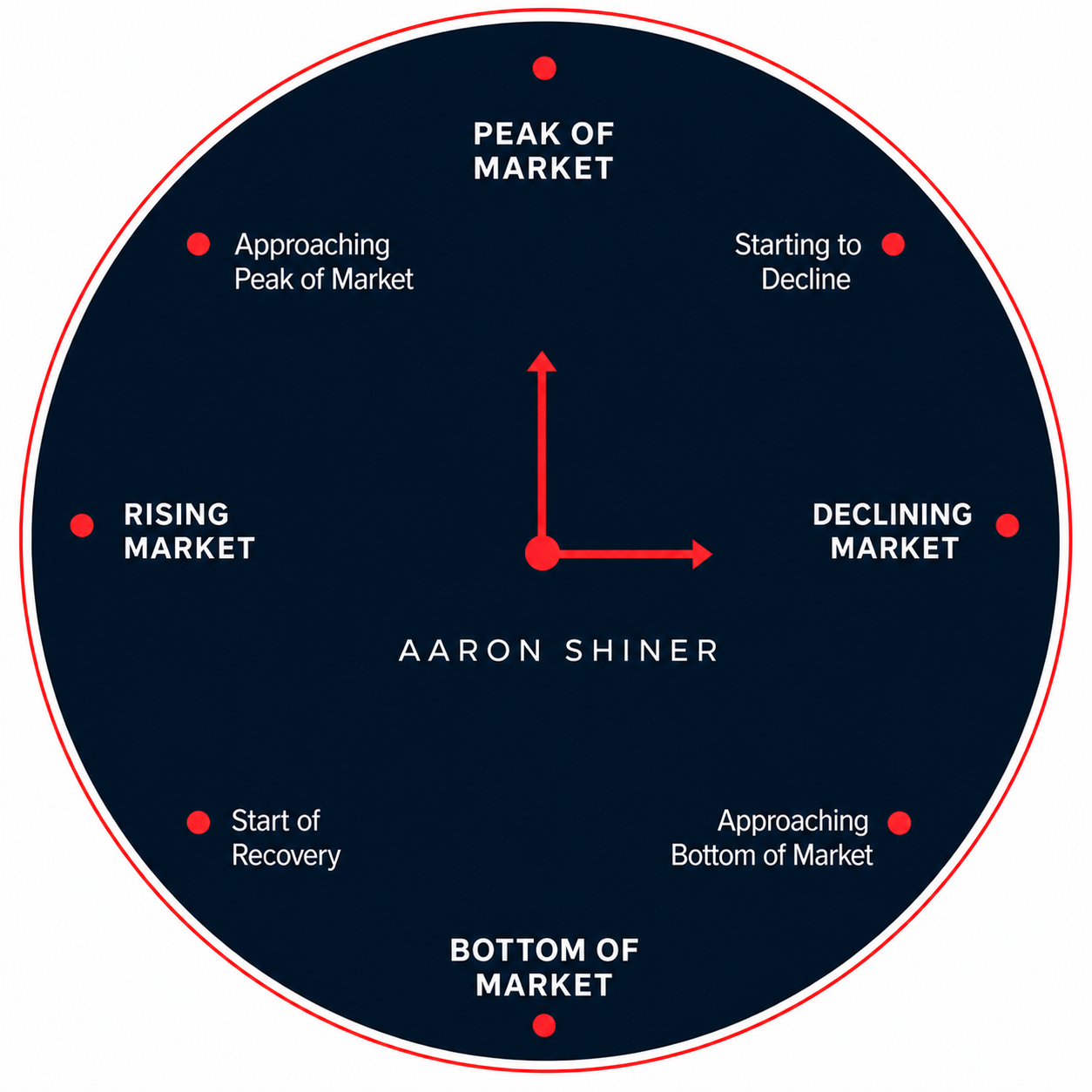
The Property Clock: How Real Estate Agents Get Vendors to Align Their Price
Watch: The Property Clock script for real estate agents (3 min) with Australias most practical real estate coach and trainer Aaron Shiner
Your vendor thinks it's still 12 o'clock. Here's how to show them the time.
Watch the 3-minute video above first. It gives you the exact words to use. This post covers why they work and how to use them this week.
Key takeaways
- The property clock is a simple way to explain where the property market sits. 12 o'clock is the peak and 6 o'clock is the bottom.
- The market only moves one way around the clock. It doesn't snap back to the peak, so waiting for last year's price isn't a strategy.
- Real estate agents use the property clock to get vendors to agree to price alignments, clear stock and keep days on market low.
- The recommendation: position the property ahead of the market. If the market is at quarter past 12, price at 12:30.
Why vendors won't move on price (and what it's costing you)
You know the feeling. You've got a listing that's been on for six weeks. The inspections have dried up, and the feedback is the same every time: "Nice home, but it's overpriced." You know the price needs to move. So you call the vendor, and they say, "Let's give it another couple of weeks."
Or it happens at the appraisal. The owner leans in: "The place two doors down got $1.4 million last year, so we're thinking $1.5."
Either way, what you say next decides whether that property sells or sits.
Every week a listing sits, it costs you:
- Buyers start asking what's wrong with it
- Your days on market climb, and so does the vendor's frustration
- The vendor blames you, not the market
- You end up chasing the market down, one price drop after another
- Your time goes into stock that isn't selling instead of winning new listings
Principals and team leaders, you feel this across the whole office: stale stock on the books, agents stuck managing unhappy vendors, and a brand that cops the damage.
Here's why it keeps happening. Telling a vendor "your price is too high" sounds like your opinion against the neighbour's sale, their mate at the barbie, and the number they need for their next place. They dig in, and you lose that argument every time.
The vendor isn't being unreasonable. No one has given them a logical way to see where the market is.
So stop arguing about price. Start talking about time.
What is the property clock in real estate?
The property clock is a model made famous by Australian valuation firm Herron Todd White. It shows where a property market sits in its cycle, and it's one of the most underused tools in real estate sales. It's simple:
- 12 o'clock is the peak of the market
- 6 o'clock is the bottom
- The market only moves around the clock in one direction
Here's the part that changes the whole conversation. A market doesn't go from 12 to 3 and then snap back to 12. It has to go all the way around, and that could take 12 months or five years.
The property clock script: what to say to your vendor
In the video, I walk you through the dialogue step by step: where the market has come from, why buyers have shifted from FOMO (the fear of missing out) to FOOP (the fear of overpaying), and where the clock sits right now. Then you make your recommendation:
"The market is at quarter past 12. My professional recommendation is we position your property at 12:30. We get ahead of this, because the longer we leave it, the harder it's going to be to hit your target."
Why the property clock works
It turns an argument into a picture. Everyone understands a clock. You're not telling the seller they're wrong. You're showing them where the market is and letting them reach the conclusion themselves.
It takes the emotion out. It's not your number against theirs. It's the market, and you're on their side of the table helping them read it.
It makes moving now the logical choice. Once an owner sees that the clock only goes one way, a price alignment stops feeling like a loss. It feels like getting ahead.
It makes you the expert in the room. When you explain something complicated in a way anyone can understand, owners trust you. And trust is what gets vendors to act on your advice.
How to use the property clock this week: a 5-step action plan
Watching this won't change your results. Using it will.
- Watch the video and write the dialogue out by hand. Make it yours.
- Role-play it five times with a colleague, your partner or the bathroom mirror, until it sounds natural.
- Pull up every listing that's been on longer than your area's average days on market. Book a catch-up with each vendor this week and walk them through the clock. Draw it on paper as you talk.
- Use it at every appraisal so new listings go on at the right price from day one.
- Principals and team leaders: make it the role-play at your next sales meeting. Pair agents up and have them take turns playing the vendor who won't budge.
Before you start, check where your area sits on the clock. Every market moves at its own pace, and Herron Todd White updates its clock every month in its Month in Review.
Ready to kick-start next year?
The best teams in the country aren't waiting until January to plan next year. They're locking in their coaching now.
January is already booked, and February is 80% booked.
Everyone makes New Year's resolutions: more listings, fewer days on market, a stronger team. But a resolution won't win a listing or get a vendor to align their price. Action will, and that's what In-House Coaching is built for.
I work directly with your team to put the right dialogue, daily habits and accountability in place. That way you start the year with momentum, not just good intentions. For most teams, a kick-start coaching session is exactly what's needed to hit the ground running.
If you're a principal or team leader and you want your team clearing stock, keeping days on market low and getting vendors to act on your advice, Pencil in your In-House Coaching dates here .
The clock's ticking. Let's get your team moving.