
World-Class Vendor Communication for Real Estate Agents in a Shifting Market
A shifting market does not create communication problems. It exposes them.
When properties are selling quickly, vendors may not notice gaps in an agent’s communication. The campaign is short, buyer competition is strong and the result often arrives before doubt has time to grow.
But when days on market increase, enquiry softens and offers sit below expectations, communication becomes part of the strategy.
Good markets create lazy agents. Shifting markets reveal skilled ones.
World-class vendor communication is not about calling people for the sake of it. It is a repeatable process that keeps sellers informed, gives market activity meaning and helps them make confident decisions based on evidence.
In the video above, I break that process into four practical components: four conversations every week, a useful vendor report, meaningful performance benchmarking and seven points of contact in the first seven days.
What does world-class vendor communication look like?
The short answer is that it is proactive, consistent and evidence-based.
Your vendor should understand what has happened, what it means and what you recommend doing next. They should never need to chase you for an update.
Having helped more than 60,000 agents over two decades and delivered 691 real estate training sessions in 2025, I have seen one pattern repeatedly: the best agents do not merely communicate more. They communicate with greater purpose.
1. Hold four vendor conversations every week
My minimum standard in a shifting market is four conversations per week:
- Monday: Review weekend feedback, campaign activity and the priorities for the week.
- Midweek: Discuss new enquiry, buyer conversations, private inspections and competing stock.
- Friday: Confirm the weekend strategy, expected attendance and buyers being actively worked.
- Saturday: Call after inspections while the feedback and emotion are still fresh.
These do not all need to be long conversations. They do need to be useful.
Consistency creates confidence. It also prevents one enormous meeting at the end of week four where you attempt to explain a month of evidence all at once.
2. Turn the vendor report into a decision-making tool
Each week, generate a vendor report using your CRM and portal reporting, including Ignite where applicable.
Include online views, enquiries, inspections, second inspections, offers, recurring buyer feedback, days on market and relevant competing sales.
But do not simply email a collection of numbers and call that vendor management.
Data without context is administration. Data with interpretation is advice.
Explain what changed, what the market appears to be saying and what action you recommend. For a deeper breakdown, use my guide on what to include in a vendor report.
3. Benchmark performance using the law of contrast
Telling a seller that their home had five inspections does not tell them whether five is good, average or poor.
Compare their campaign with the three strongest comparable campaigns in your office or marketplace. Benchmark days on market, online engagement, enquiry, inspections, offers and buyer response.
For example:
“Your property has been on the market for 30 days. The three strongest comparable campaigns reached a result in approximately 10 days. We have welcomed 20 buyer groups through your home, while those campaigns averaged closer to 50.”
Those figures are only an example, but the principle is critical.
A number in isolation is information.
A number shown beside a relevant benchmark becomes evidence.
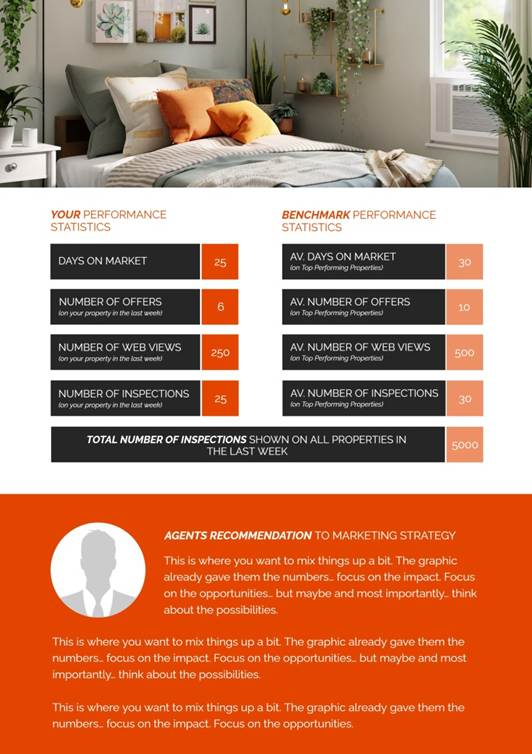
Caption: A strong vendor report compares campaign results with relevant top-performing properties, giving sellers the context needed to make informed decisions.
This is where an average agent reports activity and a trusted adviser interprets the market.
4. Create seven points of contact in the first seven days
The first seven days set the emotional tone for the entire relationship.
Many agents get the agency agreement signed and then disappear until they need to organise photography or the signboard. From the vendor’s perspective, the energy drops immediately after they commit.
Do the opposite.
Your first seven contacts could include:
- A “tuck them into bed” call on the evening the agreement is signed.
- Confirmation of the launch plan and campaign milestones.
- An update after emailing your buyer database.
- News about buyers being contacted from similar campaigns.
- Early portal enquiry and engagement data.
- Confirmation of the first inspection strategy.
- Immediate feedback and recommended next steps.
The first call can be simple:
“Mr and Mrs Seller, I know you have placed a lot of trust in me to handle this campaign. I will never promise you a price I cannot control, but I will promise you a process. I am going to put everything I have into maximising your result.”
That call answers the question every new vendor is silently asking:
“Did we choose the right agent?”
Seven points of contact does not mean seven empty messages. Every update should reduce uncertainty, demonstrate activity or prepare the vendor for a future decision.
5. Use WhatsApp and third-party evidence intelligently
A dedicated WhatsApp group can make communication faster and more visible for every decision-maker.
Use it for short updates, new enquiry, inspection reminders, buyer comments, comparable results and useful market information. If a credible article, data release or video supports the conversation, share it and explain why it matters.
WhatsApp provides speed.
Your vendor report provides depth.
Your conversations provide meaning.
Turn this into a vendor communication skills audit
Rate your current vendor management system out of 10, then ask:
- Does every vendor receive four meaningful conversations each week?
- Does every report contain interpretation and relevant benchmarks?
- Do we make seven useful contacts during the first seven days?
- Are our updates proactive, or do vendors need to chase us?
- Does every seller understand what the evidence means and what happens next?
Choose the weakest area and improve it this week.
Effective real estate coaching and real estate training should not make the business more complicated. It should turn the right behaviours into a repeatable standard across every agent and every listing.
The market will shift again. It always does.
The agents who win will be the ones whose vendors feel informed, supported and expertly guided, regardless of market conditions.
Start with four conversations.
Add meaningful benchmarks.
Win the first seven days.
Then make it your standard.
Frequently asked questions
How often should a real estate agent communicate with a vendor?
In a shifting market, I recommend at least four meaningful conversations each week: Monday, midweek, Friday and Saturday after inspections.
What should a real estate vendor report include?
Include campaign engagement, enquiries, inspections, offers, buyer feedback, days on market, comparable results, performance benchmarks and a clear recommendation for what happens next.
Why is vendor communication important in a changing market?
Regular, evidence-based communication builds trust, manages expectations and helps sellers make informed decisions before a campaign loses momentum.
About Aaron Shiner
Aaron Shiner is an Australian real estate coach, real estate trainer, speaker and co-founder of LockedOn CRM. He has helped more than 60,000 agents over two decades and delivered 691 coaching and training sessions in 2025, providing practical scripts, systems and strategies for agents and sales teams across Australia and New Zealand.
